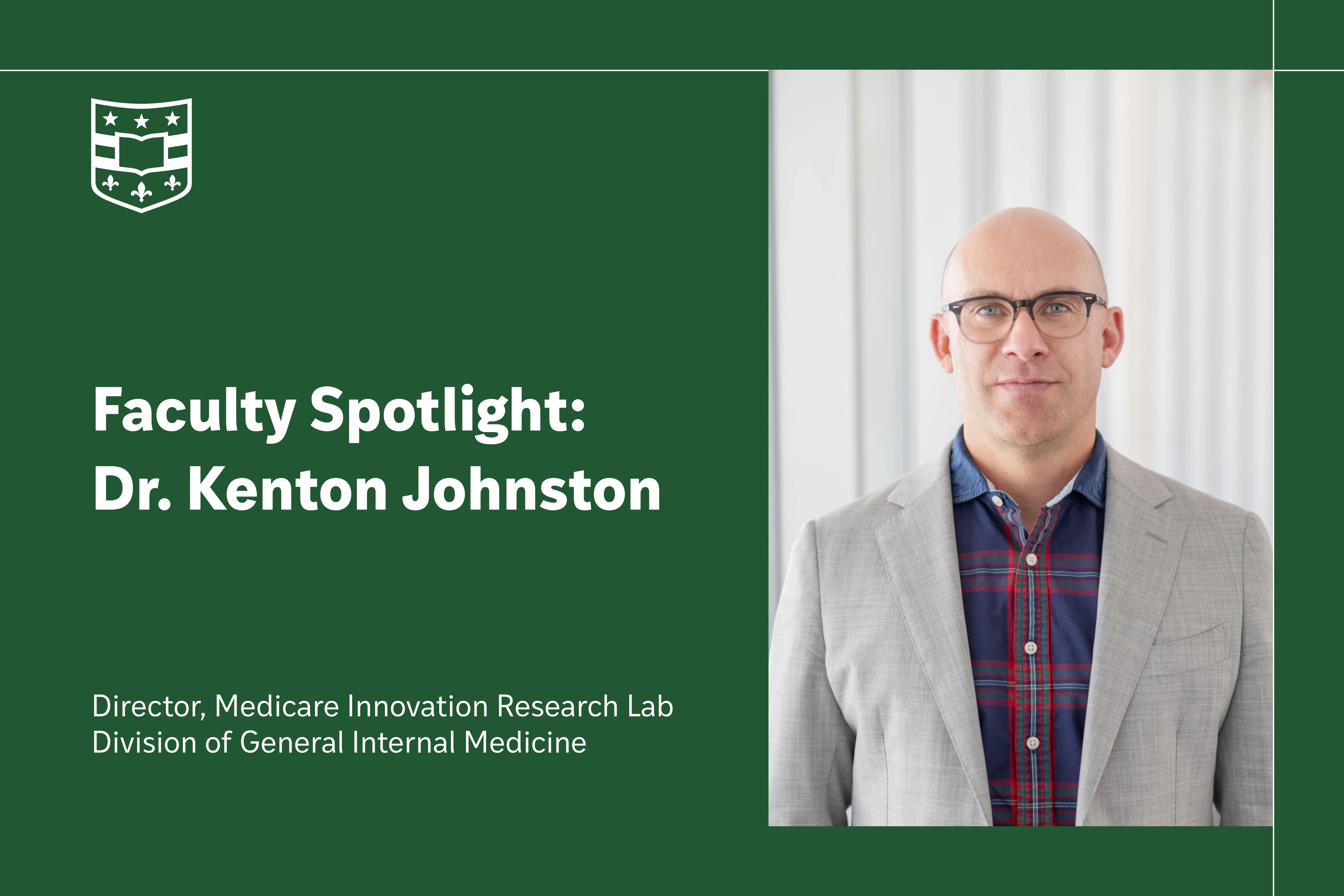
Kenton Johnston, PhD, an associate professor in the Research Section of the Division of General Internal Medicine, leads health services research focused on health policy for patients and healthcare providers within the Medicare system. He serves as director of the Medicare Innovation Research Lab at WashU Medicine and Associate Director for Research at the Center for Advancing Health Services, Policy, and Economics Research (CAHSPER). He also has a secondary faculty appointment in the Bursky School of Public Health.
Johnston found his passion for health services research while earning his Master of Public Health degree. After working in the private sector for BlueCross BlueShield for nearly a decade, he earned a doctorate in health policy and economics from Emory University to advance his career as an investigator.
Today, Johnston is principal investigator on a $3.7 million, 5-year R01 grant from the National Institutes of Health to study Medicare and Medicaid dual-eligible special needs plans for individuals with intellectual disabilities. Johnston and Dr. Harold Pollack at the University of Chicago are MPIs on this award.
“The majority of adults with intellectual disabilities—definitely with more severe intellectual disabilities—rely on those two insurance programs,” Johnston said. “And no one is really studying that at the national level to understand what parts of Medicare and Medicaid work best for them.”
The project will study the availability of and enrollment in Dual-eligible Special Needs Plans and compare the effects of enrollment in integrated D-SNPs versus other dual coverage models on quality of care and health outcomes.
“The ultimate goal is better patient health outcomes.”


Read more: Johnston receives R01 for research on dementia care for adults with intellectual disabilities »
Q&A with Dr. Kenton Johnston
Can you describe the general focus of your research?
My focus is on the Medicare and Medicaid programs. Those are the two big public health insurance programs for Americans.
Medicare is a federal program that serves older adults ages 65 and up, individuals with disability entitlement through Social Security, and people with end-stage renal disease or ALS. Medicaid, which is a state-run program in partnership with the federal government, primarily serves low-income Americans, including many individuals with disabilities and frail older adults living in nursing homes, as well as children, pregnant women, and families.
A lot of my research is focused on how physicians get paid in Medicare, or on managed care for patients with disabilities or neuropsychiatric disorders—in particular intellectual disabilities, mental health conditions, or dementia—in both the Medicare and Medicaid programs, with a special focus on those who are dually eligible. Dual-eligibility means beneficiaries have both Medicare and Medicaid insurance.
How can your research impact patient care?
That’s a great question.
So inside of Medicare and Medicaid, it’s not really a homogenous program where everything’s the same.
In Medicare, you can belong to what’s called the “fee-for-service program,” where your insurance is provided directly from the Centers for Medicare and Medicaid Services (so direct from the federal government). Or you can be part of a Medicare Advantage plan, which is where the federal government essentially pays a private health insurer or managed care company, and you have your insurance through them. Think of Blue Cross Blue Shield or Humana or Aetna or another insurer like that. Depending on which private plan you’re in, your type of insurance can be different. Your co-pays can be different. Your network of doctors can be different. More than half of the people in Medicare now are in those kinds of managed care plans.
And then in Medicaid, there’s an even higher presence of managed care. If you have Medicaid, in a lot of states you actually have your insurance through a company like Centene here in St. Louis or through other managed care companies. So the way your insurance works, the way they pay doctors and hospitals and other health care providers, and the kind of benefits you get in Medicare and Medicaid can vary. It can be different from plan to plan.
A lot of the research I’m doing is looking at who’s enrolled in what specific kinds of plans. And then what features of those plans may be best for patients. What features of those plans help coordinate their care or help them get better preventive care and better quality of care? The ultimate goal is better patient health outcomes.
What are some of the complexities of Medicare and Medicaid programs?
Navigating health insurance can be particularly challenging for people who are dually eligible for Medicare and Medicaid. Typically, the insurance plans are separate and are offered by different managed care organizations in Medicare and Medicaid.
Some of my research has looked at integrated plans—or integrated dual-eligible special needs plans—where the insurer is the same. For example, if one insurer owns both the Medicare and Medicaid plan, they could offer it to eligible people as an integrated product. The goal of this type of integrated dual-eligible special needs plan is to have fewer entities involved in managing insurance benefits.
If you’re a beneficiary, it would be more convenient to have one insurance card, one help number to call to manage your benefits or take care of any issues if something didn’t get paid, for example.
Health insurance is really complicated, right? With Medicare and Medicaid, there are a lot of different plans to pick—particularly in Medicare, if you choose a private plan. And so I’ve written some about how to better set up a system so that it’s easier to navigate for beneficiaries.
It’s, you know, it’s confusing to figure out for me, and I have a PhD in health policy, never mind if you’re retiring or just becoming eligible for Medicare and trying to figure this out for the first time. When you were employed, your HR department probably offered you a couple of plans to pick from. Now, in your county, there might be something like 40 Medicare Advantage plans to pick from. It can be really complicated. There are brokers who can help, but they can sometimes be financially conflicted. Then there are community organizations that help people as well. I’ve published a little bit of research about that.
It’s always revealing to me when I help a friend or family member. Choosing a plan is very different than doing research on the topic. You’re presented with all these options. The brokers are telling you this and that. What should you do?
Can you share more about your new R01 grant to study special needs plans for people with intellectual disabilities?
First of all, there’s just a real need for research on the health system for people with intellectual disabilities—particularly adults as they age. There are not a lot of people doing research in that area, and there’s a real need for it.
A huge segment of adults with intellectual disabilities rely on Medicare and/or Medicaid for their health insurance. I would say the majority of adults with intellectual disabilities—definitely with more severe intellectual disabilities—rely on those two insurance programs.
In particular, people often think of intellectual and developmental disabilities as more of a pediatric phenomenon, but people with intellectual disabilities are living longer lives into older age and, over time, adult and geriatric care becomes really important. For example, people with Down syndrome are at much higher risk for early onset Alzheimer’s and dementia.
That’s kind of the focus of this grant, in particular. We’re focusing on people with intellectual disabilities like Down syndrome as they age. Does it make a difference what health insurance plan they’re enrolled in through Medicare and Medicaid?
The question we’re asking is: Do these fully and highly integrated dual-eligible plans where Medicare and Medicaid are either provided through the same insurance plan or related entities within the same parent organization, lead to better access to care and better quality of care? No one really knows the answer to that. This is an opportunity for us to study Medicare and Medicaid as health insurance systems for people with disabilities as they age. We’re going to look at what features, particularly in the integrated plans, have better outcomes for patients.
What is the Medicare Innovation Research Laboratory?
When I came to WashU Medicine in 2022, I established the Medicare Innovation Research Laboratory to focus on research projects related to Medicare. The “Innovation” part of the name comes from our emphasis on research that focuses on new payment models that are used for physicians or hospitals, or new payment models within Medicare and Medicaid—like the integrated dual-eligible special needs programs we’re studying in this new R01.
The lab includes myself and a great team, currently consisting of: Dr. Alex Everhart, a faculty member who does a lot of work with me on physician payment models; Dr. Michelle Hendricks, a research statistician; the lab operations manager, Megha Dabas; and a trainee, Dr. Amanda Davis, who is a recent PhD graduate and visiting researcher from Boston University.
Did you always know you wanted to conduct this kind of research?
I didn’t always know that I wanted a career in research. It really wasn’t until I did a Master of Public Health degree and realized that I loved research, statistics, epidemiology, and health economics, that I knew I wanted to be in research somehow.
After earning an MPH degree, I worked for about eight years at BlueCross BlueShield of Tennessee. That’s really where I learned about the health system and realized how much I loved research. And then eventually realized that, you know, I’d really like to be the one who could come up with my own research questions and have the freedom to publish. And so, at that point, I went back to school and did my PhD in health policy and health economics at Emory University.
After graduating from that program, I started my research career in academia at Saint Louis University as an assistant professor, then an associate professor. And then I started working with some folks at WashU, and I joined the faculty here in 2022.
My experience of growing up with a father who had a physical disability made me particularly cognizant of the challenges that folks with disabilities face and the importance of having a good health system to meet the needs of people with disabilities. I came to learn about the unique gifts and needs of people with intellectual disabilities in particular as a PhD student through reading the works of a Dutch priest, writer, and chaplain to people with intellectual disabilities named Henri Nouwen. That led me to volunteer at local chapters of the international organization that he was a part of called L’Arche—both in Atlanta and here in St. Louis. After that, I realized that there was a real need for research to understand and improve the Medicare and Medicaid systems for people with intellectual disabilities here in the U.S. and made an intentional pivot to focus my research on this area.
What drew you to WashU Medicine?
It was definitely the existing collaborations that I had with people in medical school. Particularly in the Center for Advancing Health Services, Policy & Economics Research. I have extensive collaborations with Karen Joynt Maddox, the center’s co-director. I also knew the other folks in the center, Tim McBride and Abigail Barker, pretty well, who at that time were in the Brown School of Social Work. There were others at WashU who I knew from collaborations, including at the new WashU Bursky School of Public Health, like Derek Brown.
I chose WashU because there were great research collaborations, and the medical school invested in my research to help me establish the Medicare Innovation Research Lab.
What makes WashU a great place for research?
WashU Medicine is a very strong school for research. Research has been a main focus of the medical school throughout its history.
If you’re going to talk about the St. Louis area—or the Midwest more broadly—WashU is a powerhouse when it comes to research, particularly in the health sciences area, which happens to be my focus.
Also, the Bursky School of Public Health is a great complement to the School of Medicine. Together, the two schools create an opportunity for collaborations between medicine and public health, combining strong clinical and bench science research with population health and health services research.
What is your favorite thing about St. Louis?
When I came to St. Louis, I don’t think I initially intended to be here long, but St. Louis truly grows on you. I moved here in 2015, so it’s been over a decade.
What are my favorite things? Low cost of living is one thing. Not to mention St. Louis also has so many excellent free attractions. The zoo and the art museum are both great.
The parks are another. I love running in Forest Park. I live close to Grant’s Trail, which is a big trail that goes through St. Louis County all the way to the Mississippi River, and I enjoy running and biking along Grant’s Trail.
And the people. I’ve met a lot of great people in St. Louis.
Also, it’s not stressful getting around the city. In some other large cities, traffic can be terrible.
The fall season is beautiful in Missouri. You can head just a little bit south of St. Louis and get into the Ozarks for some nice hiking and fall colors.